London's transport network is divided into six concentric fare zones, numbered 1 through 6. These zones are radiating outward from the city centre. Zone 1 covers Central London. Zone 6 reaches the outer boundaries of Greater London, including Heathrow Airport.
The zone you live and travel in directly affects what you pay for transport, how long your commute takes, and where your money goes as a student.
That's why it is important for you to understand the zones of London clearly as an international student.
How the London Zone System Actually Works
The zones work like concentric rings on a map. Zone 1 is the innermost ring, covering the historic and commercial core of London. Each subsequent zone adds another ring, with Zone 6 being the outermost layer. When you travel, the fare you pay is determined by how many zone boundaries your journey crosses, not simply by distance.
A Zone-by-Zone Breakdown: What Each Zone Contains
The zones work like concentric rings on a map. Zone 1 is the innermost ring, covering the historic and commercial core of London. Each subsequent zone adds another ring, with Zone 6 being the outermost layer. When you travel, the fare you pay is determined by how many zone boundaries your journey crosses, not simply by distance.
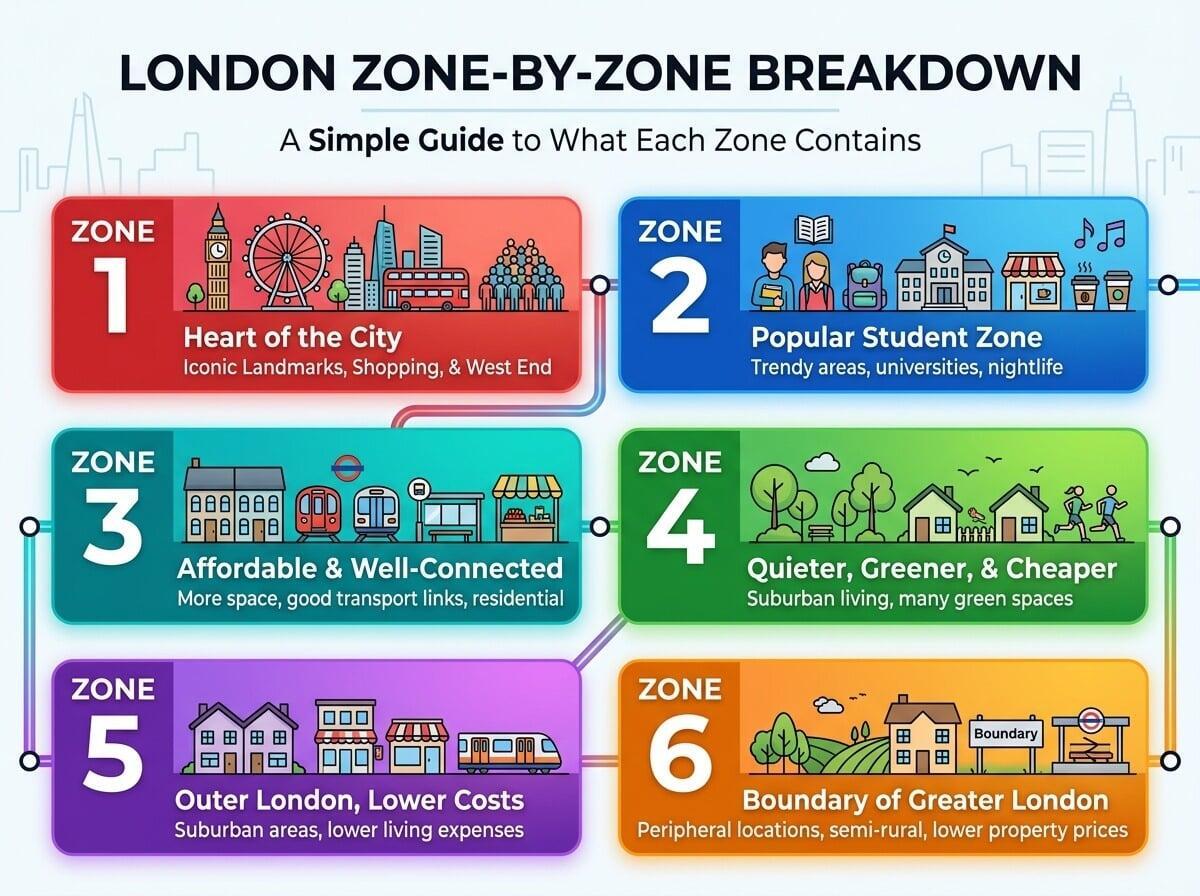
Zone 1: The Heart of the City
Zone 1 covers London's most recognisable locations. Oxford Circus, King's Cross St. Pancras, London Bridge, Waterloo, Paddington, and the City of London all sit within this zone. Most international students will study in or near Zone 1, even if they do not live there.
However, you must remember that living in Zone 1 is expensive. Average rents here are among the highest in the country.
Zone 2: The Most Popular Student Zone
Zone 2 is where a large proportion of London's student population lives. Areas like Brixton, Hackney, Finsbury Park, Islington, and Shepherd's Bush all fall within Zone 2.
A Zone 2 location typically means a 15 to 25-minute Tube journey into the city centre. For most students, this is the sweet spot to live because they get access to central London easily without paying the hefty rents.
Zone 3: Affordable and Well-Connected
Zone 3 pushes further out into areas like Wimbledon, Ealing, Stratford, and Lewisham. Rents drop noticeably here compared to Zones 1 and 2. Transport into the centre remains manageable for most of the students.
Many families who host international students live in Zones 3 and 4, making this highly relevant for anyone planning a homestay arrangement.
Zone 4: Quieter, Greener, and Cheaper
Zone 4 includes areas such as Wembley, Barking, Sutton, and Kew. These are quieter, more residential parts of London. The housing stock tends to be larger here, which is why Zone 4 is popular among host families.
Commute times from Zone 4 into central London range from 35 to 55 minutes, depending on the line and the time of day.
Zone 5: Outer London, Lower Costs
Zone 5 covers areas including Enfield, Chigwell, and Bromley. This is outer suburban London. Rents are substantially lower, but commute times increase. Students who choose Zone 5 generally prefer affordability over everything else.
Zone 6: The Boundary of Greater London
Zone 6 is the furthest ring in the London underground zone system. It includes Heathrow Airport, Upminster, Chesham, and Croydon. Most students do not live in Zone 6 unless they are studying at institutions in the outer boroughs.
A Zone-by-Zone Breakdown: What Each Zone Contains
The zones work like concentric rings on a map. Zone 1 is the innermost ring, covering the historic and commercial core of London. Each subsequent zone adds another ring, with Zone 6 being the outermost layer. When you travel, the fare you pay is determined by how many zone boundaries your journey crosses, not simply by distance.
Which Zone Is Best for International Students Living in London?
The best zone for an international student depends on three things: budget, location, and accommodation type.
Priority | Recommended Zone |
Lowest cost | Zone 4, 5, or 6 |
Shortest commute | Zone 1 or 2 |
Best balance of cost and commute | Zone 2 or 3 |
Homestay with a host family | Zone 3 or 4 (most common) |
Near Heathrow arrival point | Zone 6 (temporary), then relocate |
Practical Transport Tips for International Students New to London
The 18+ Student Oyster card reduces fares:
Students aged 18 or over who are studying in London full-time can apply for an 18+ Student Oyster photocard, which gives off adult rate Travelcards and Bus and Tram Pass season tickets.
Night Tube and night buses cover the hours when regular services stop:
The Night Tube runs on five lines (Central, Jubilee, Northern, Piccadilly, and Victoria) throughout Friday and Saturday nights. Night buses cover the gaps across all zones every night of the week.
Safety and belongings:
Be alert on crowded platforms and buses; keep valuables concealed to reduce pickpocket risk.
Practical Transport Tips for International Students New to London
The 18+ Student Oyster card reduces fares:
Students aged 18 or over who are studying in London full-time can apply for an 18+ Student Oyster photocard, which gives off adult rate Travelcards and Bus and Tram Pass season tickets.
Night Tube and night buses cover the hours when regular services stop:
The Night Tube runs on five lines (Central, Jubilee, Northern, Piccadilly, and Victoria) throughout Friday and Saturday nights. Night buses cover the gaps across all zones every night of the week.
Safety and belongings:
Be alert on crowded platforms and buses; keep valuables concealed to reduce pickpocket risk.
Find Your Ideal London Homestay With Host Family Stay
Host Family Stay is one of London's most trusted homestay providers. We place students with host families in Zones 2 to 6, ensuring every student has reliable access to their school or university without paying more for transport than necessary.
Apply now and find a homestay placementin the right part of London before spaces fill up.